
Traveling as a Child/Parent

Map Reading along the Lewis & Clark Trail
As a child, my family traveled more than most anyone I know, and I am very thankful to my parents for that. (Who knew that traveling across all of Central America and Mexico to get from Panama to Massachusetts was so uncommon?) As a parent myself, I have worked hard to share that joy with my children, looking for every excuse to work in a road trip. (A family reunion in Montana? Let’s drive from Alabama – oh look we can drive to St. Louis and follow the Lewis and Clark Trail till we get there. Oh wait, you want to see the Pacific Ocean while “we’re so close”? Why not?)
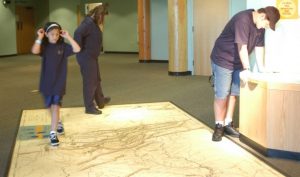
Needless to say, as a homeschooler, I saw/see the educational value of travel, and have always been saddened to hear about others who are not so inclined. Most of my children learned their map reading skills as we crisscrossed the United States. They learned about animals up close and personal not only from the zoos and aquariums near where we lived, but also from countless ones we worked into our travels.
What an Amazing World!
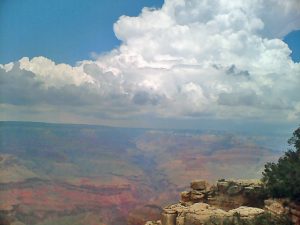
A View of the Grand Canyon
It’s an amazing world out there and I’m glad I have been able to share much of it with my children/students. I’ve taken quite a few students to D.C. who had never traveled beyond the borders of our state. I’ve stood on the edge of the Grand Canyon and marveled with my children over how amazing it is. And I’ve stood on the balcony of a cruise ship and taken in the vastness of the heavens and enjoyed the stars without number that we could see.
Inexpensive Travel
 The beauty of traveling is that it doesn’t have to be expensive. My family has taken LOTS of people on a seemingly never ending supply of road trips – even when our budget felt stretched to the limit. When money is tight we tend to take more food with us for “picnic meals,” rather than eating out as often. We also look for cheaper overnight accommodations: everything from sleeping in our vehicle (we drove a customized 15 passenger van for 10 years), camping, or staying with family and friends (even when we maxed out with 13 of us we occasionally found people willing to put us up; and now, as we generally travel with a smaller number, those people are even easier to find).
Enjoy the Journey
We try to make the journey as important as the destination as often as we can. (Sadly, when time is a factor that isn’t always an option.) But when we have the flexibility to do so, we take our time getting from point A to point B, taking time to enjoy any number of special places we might have missed, or adding visits with family and friends who happen to be “along the way.” On our most recent trip we could have driven straight from home to Houston, Texas. But we took a couple of detours to visit family in Austin and McAllen – neither were particularly en route, but we had the time, and it was good to see family while we were “so close.”
Benefits of Travel
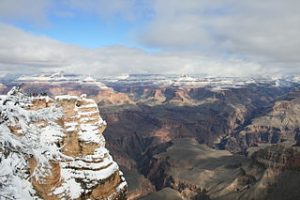
Another Lovely View of the Grand Canyon
One of the reasons I see the strong educational value of travel is the exposure to other cultures coupled with the geography, history, and nature found on trips. It is difficult to accomplish the same thing within the pages of a book. Even the best photos just don’t do justice to the Grand Canyon. And the experience of standing where Lewis and Clark stood, seeing the battlefield where men fought and died for freedom, or being in a courtroom where life changing legal decisions were made, cannot be equaled!
Memberships and Passes
Throughout our travels we always look for memberships and passes to purchase. Those have ranged from our National Park pass to memberships at many other types of places: art museums, aquariums, history museums and science museums, and zoos. All of those could then be used in additional places across the country. With a big family, it seldom took more than two visits for us to come out ahead with those, but even the smaller families I know have figured out the value of such investments! And it’s amazing what a “quick” stop at a zoo or a children’s museum can do to break up a long day of traveling!
Scavenger Hunts and More
Many places have great resources on their websites that can add to the educational value of a stop (scavenger hunts are an especially fun addition to a visit when those can be found). And the Junior Ranger programs available at most national parks we visited are among our favorite on-site resources.
Time for More Travel?
 Regardless of your family size, your children’s ages, or your budget, I am confident that you can find a way to include more travel in your family’s weekly, monthly, or annual plans (even amazing day trips count!).
And when you go, be sure to incorporate photos, journals, and mapping skills into the trip; you will be able to work those into some of your post-trip fun and follow-up!
Happy traveling!
Cathy
We would love to hear some of the ways you’ve made traveling more fun, affordable, and/or educational for your family.





 Of course, with seven of us in that van, space was at a premium. As we planned the trip, we quickly decided that seven suitcases going in and out of the hotels almost every night would be a bit insane. So, we went with three very large suitcases and one smaller one.
 In each of the large suitcases we packed two days of clothes for each of us. And in the smaller suitcase we packed our overnight stuff and our swimsuits. That way we only took in two suitcases each night – the small one and one of the larger ones. Most times we were staying in a hotel for just one night, but on several occasions we had more to see in the area, and we planned a two-night stay. Of course, on those nights we made sure we brought in a suitcase that still had two days’ worth of clean clothes in it.
 And of course, we had to do laundry several times on the trip, since it was a 20-day trip and we only brought seven days’ worth of clothes. I did laundry one night at a hotel while the kids (which included my 27-year-old daughter) hung out at the hotel’s pool with a water slide. And I did it another time at a laundromat, so I could get our many loads done quicker.
 For that trip, we had our general route planned out at least as we headed north and west from St. Louis (that was easy, since we were staying as close to the Lewis and Clark Expedition as we could do in a car). We had considered camping, to save some money, and be more like the Expedition, but we gave up that idea pretty early into our planning – we would have had to bring more gear for camping, which would have pushed us over the edge for fitting into our minivan. And it would have made it more difficult to arrive at our destination late at night, which we often did.
 So, we decided to splurge and go with hotel rooms, a decision we were very happy with. (We saved money in other ways – keeping a big cooler in the van with sodas and the makings for lunch meat sandwiches, so we typically only ate fast food once a day, and then only with water.)
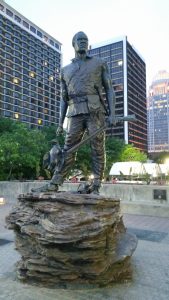
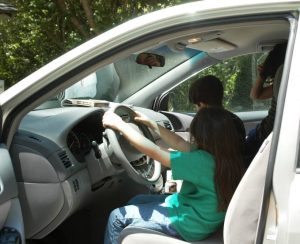 We started the trip with our first two nights’ reservations made. Our first day’s drive got us to the St. Louis area, where we knew there would be much to see and do; since the expedition had officially begun at Camp Dubois, just a bit outside of St. Louis. But we had no other reservations made beyond that, because we didn’t know how far we would get each day. We had to make an average of 260 miles each day, in order to make it to the Pacific Ocean and then back to Montana for a family reunion in two weeks. But other than that, the schedule for those first weeks was fairly flexible.
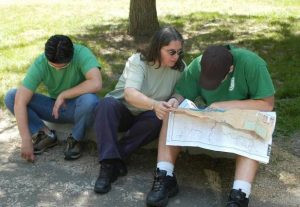 So we worked out the details as we went along. My oldest did almost all of the driving, and I played navigator and tour guide. Depending on what there was to see and do on each particular day, would determine how close to the average we actually got. Some days there were too many sites to visit, and we logged significantly less miles. But some days the drive was the main event, and we could make up some of the earlier “missed” miles.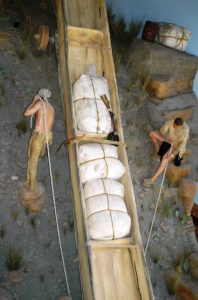
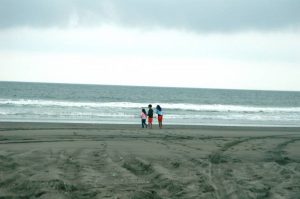 By the time we made it to the Pacific Ocean we had all seen, done, and learned an amazing amount of things connected to the Lewis and Clark Expedition!