To say that I am a long-time creationist would be an understatement. My husband and I listened to our first debate on creation versus evolution decades ago when we were college students. And I have read, watched, or listened to a wide variety of creation resources over the ensuing forty plus years. Needless, to say I’m a big fan of Ken Ham’s work with Answers in Genesis.
And since we live in northern Alabama, less than 400 miles from the Creation Museum, we have made many trips there. In fact, we became members in 2008, within a year of their opening, and have had some sort of membership there ever since. We probably only average one trip per year, but with the size of our family, one trip per year has still made memberships a worthwhile investment. This is something I found to be the case almost any place I took my kids – from zoos to aquariums to most museums. (For example, in 2005, on our Lewis and Clark adventure we got a one year family membership at Fort Mandan’s Lewis and Clark Interpretive Center – knowing there was almost no chance we would be back in North Dakota within the next twelve months – but we were still better off getting the membership.)
In addition to numerous trips with family members, I’ve taken students to the Creation Museum twice and the Ark Encounter once (it was still just a dream the first time I took students up there.)
Every trip has been a little bit different, of course, but every one of them has been worthwhile. On this most recent trip, we did the Ark Encounter first. It was the second time my daughter and I had been, and we had the privilege of introducing four others to it (two teens and two older adults). As expected, a good time was had by all. And there is something awe-inspiring about seeing a life-size ark, and then going inside and imagining (with the help of some wonderful creative effects) how Noah’s family and all those animals would have lived and worked in such a space for over a year.

The exhibits at both museums are extremely well done – from both a visual aspect and an information one. Since my daughter and I had been before, we were able to focus on some of the exhibits that we had only glossed over the first time, as well as enjoying several that were new since our first visit.
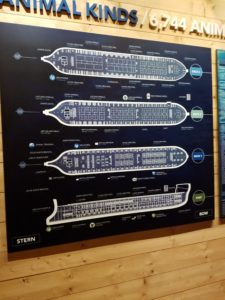
One of My Favorite New Exhibits at the Ark Encounter
Because there is so much to see there, it is most definitely the type of place that begs for a return visit (or 2 or 3 or …), hence the beauty of a membership. It’s just really hard to take it all in at one time.
Additionally, I strongly recommend against trying to do both the Ark Encounter and the Creation Museum in one day. I met a couple as we were finishing the Ark who had done them both that day, and it made me tired just listening to them. There is so much to see and do at both places that I cannot imagine doing that – there would be no way to fully enjoy both places if you were trying to cram them both into the same day.
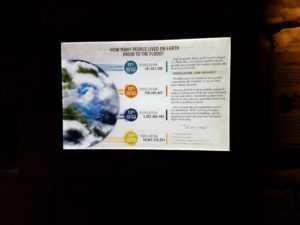
Population: What we know versus what we can only deduce.
And at the Creation Museum, be sure to include a planetarium show if at all possible. We have watched one almost every time we have been there, and never get tired of them – with our favorite being Created Cosmos.
So, again, my recommendations for getting the most out of your trip to the Creation Museum and the Ark:
The absolute best option is to get an annual combo pass so that you can go to both the Ark Encounter and the Creation Museum two or more times in a twelve month period.
Next best is to get a ticket that includes both – and go to one on one day and the other one on the next day. We actually did one on Tuesday and one on Thursday on our last trip, and visited the Newport Aquarium in between the two. No right or wrong way to do it!

Even the diversity of the fish at the aquarium tell the story of Creation.
But, if those are not options, and you have the endurance for it – visit them both in one day – just know that you’ll be really tired at the end of the day! (Also, figure in forty-five – ninety minutes to get from one to the other and park. At the Ark Encounter you will be parking and riding a shuttle to the Ark itself, and at the Creation Museum you may end up parked far enough away to where you prefer to ride the shuttle bus. And of course, all that adds to the time factor.)
And, if you just can’t work in the time or the money for both, you can’t go wrong with either. The friend I took this last time enjoyed the Ark more – feeling like she was “encountering Noah and the Flood” in an entirely new way there. But, the Creation Museum might be my choice for just one, because it covers such a broad array of topics within the area of creation, including a small exhibit on the ark. But again, neither would be a bad choice.

This is part of what I like throughout the beginning of the Creation Museum – the explanations of Present vs. Past.
Both places have restaurants that you can eat at if you are there over a meal (we usually are) and don’t want to pack a picnic (we usually can’t). The restaurant at the Ark became a buffet between our first and second trips there, which made it a little more expensive than we had planned on, but it was actually an exceptional meal, so in the end we all decided it had been worth it, and we will gladly eat there again on future trips.
Whether you are “in the area” or have to make a special trip to the greater Cincinnati area for these, I strongly encourage you to work these into your trip. If you want to share good, solid Creation information with your students or family, or just want to increase your own knowledge, you can’t go wrong with the Ark Encounter and/or the Creation Museum.
Each place has done an exceptional job of bringing together great displays with good information, in a family friendly location, suitable for children and adults alike. There are inside portions, and weather permitting, some nice outside portions at both as well – including a petting zoo and nice botanical gardens.

Happy traveling and learning!
Cathy











 Depending on what part of the country you’re in, school has either just started or will likely start sometime in the next several weeks. (Having gone to school mostly in the North, the start of a school year belongs after Labor Day in my mind, and that’s generally how I structured my classes. But I know that not everyone has that amount of flexibility.)
 It’s not that students can’t receive a good education in a private or public school situation – many of them do. It’s not that there aren’t good teachers in those settings – many of them are. (Both my Mom and Dad were teachers at different times in their careers. I respect the hard work done by them and the many other dedicated teachers out there.) And it’s not that every parent is cut out to be responsible for supervising the education of their own children – but I find that many of them are!
 The
The  I never wanted my home to feel like an institution, and after I got started on my journey of educating my own children, I also didn’t want it to feel like a school. This wasn’t just about giving instruction! Helping my children receive their best education became my goal. Not someone else’s definition of “the best education” either – but what was best for each of them.
 Did I always accomplish my goals with them? Of course not. But my primary goals were to help give them a love of learning and the tools to learn. Now that they are all adults, I think it’s safe to say I was fairly successful in those goals.
 At sixty, I’m now semi-retired, with full retirement likely right around the corner. What retirement means to me is that I get to spend my time learning what I want to learn – which is an amazing freedom that I hope to fully take advantage of. Of course, I spend much of my learning time on the history that goes with my current writing project (
 But of all the things I’m currently making time to learn, the drawing lessons I’ve been doing have to be the most fun. I’ve wanted to learn to draw for a long time, but like anything else, it’s a task that takes time. This summer I’ve finally decided to make that time. I’ve been working out of several “learn to draw” books for about a month now. And I can actually see progress in my drawings. It’s very exciting.


 Today I will share several others. But first, I want to reiterate a couple of things from my


 For another one of our activities we were broken into small groups, each with a portion of a different scene. Each group had the same number of people as their scene had characters. As a group we had to choose five places from our scene that we could take “snapshots” of – where we could quickly “act” them out (more of a posed three-dimensional picture for each place.) The idea was to visually represent the highlights of our little scene.
 I don’t want to turn my Shakespeare classes into acting classes – plenty of others already offer those. I want to keep my emphasis on reading and enjoying Shakespeare. But I can see how these types of activities, sprinkled sporadically amongst our readings could add a new dimension to our Shakespeare understanding and enjoyment.


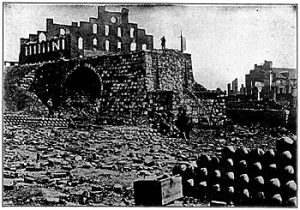
 So, you might be asking, if I’m going to teach something smaller, like say, the Civil War, and I’m not going to use a curriculum, what am I going to use? There is an endless supply of resources for teaching history – from field trips to movies to “real” books – both fiction and non-fiction. My family spent an entire school year studying the Civil War. (I put our favorite resources in my book,